
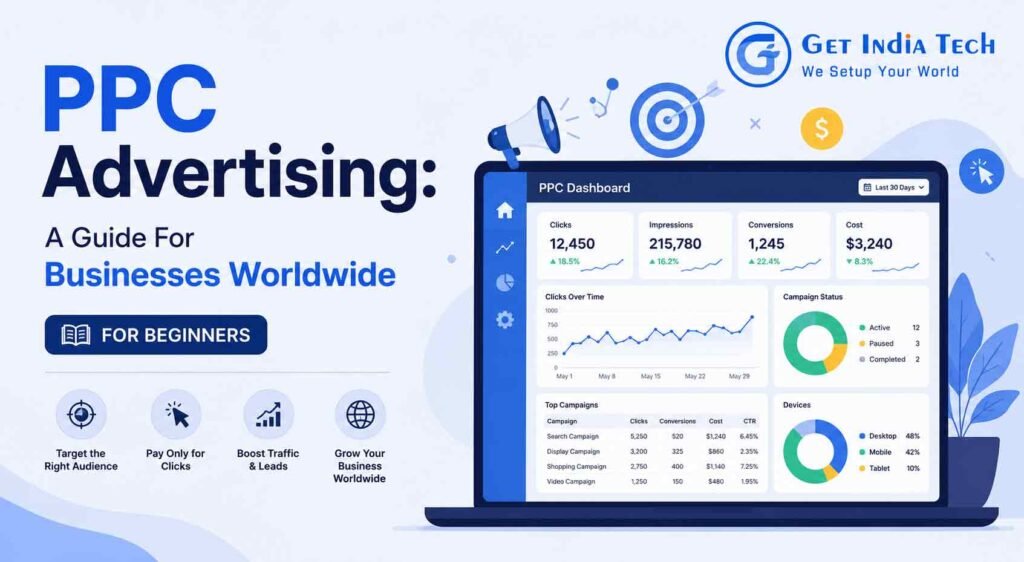
Every business wants more visibility, qualified leads, and consistent sales. However, reaching the right audience has become more challenging as online competition continues to grow. Organic marketing is valuable, but it often takes time before noticeable results appear. This is where PPC Advertising becomes one of the most effective digital marketing strategies available.
Whether you operate a local business, an eCommerce store, a SaaS company, or a multinational brand, PPC Advertising allows you to place your business directly in front of people who are actively searching for your products or services.
Unlike traditional advertising, you only pay when someone clicks on your advertisement, making it a measurable and performance-driven marketing approach.
In this guide, you’ll learn everything you need to know about PPC Advertising, from the basics to advanced optimization techniques, helping your business achieve sustainable growth.
What is PPC Advertising?
PPC Advertising (Pay-Per-Click Advertising) is an online advertising model where advertisers pay a fee each time someone clicks on their advertisement.
Instead of waiting months for organic rankings, businesses can immediately appear at the top of search engine results pages through paid advertisements.
Popular PPC platforms include:
- Google Ads
- Microsoft Advertising (Bing Ads)
- Facebook Ads
- Instagram Ads
- LinkedIn Ads
- YouTube Ads
- Amazon Advertising
These platforms allow businesses to target users based on:
- Keywords
- Location
- Age
- Interests
- Devices
- Language
- Purchase behavior
- Audience segments
The biggest advantage is simple—you reach people who are already interested in what you offer.
Why PPC Advertising Matters for Modern Businesses
Today’s consumers expect instant answers. When they search online, they usually click one of the first few results they see.
With PPC Advertising, your business can secure those premium positions without waiting for long-term SEO improvements.
Major benefits include:
Instant Visibility
Your advertisements can appear within hours after launching a campaign.
Highly Targeted Marketing
You control who sees your ads based on demographics, interests, devices, geographic locations, and customer behavior.
Measurable Performance
Unlike traditional marketing, every click, impression, conversion, and dollar spent can be tracked accurately.
Flexible Budget Control
Businesses can start with modest budgets and gradually increase spending as campaigns become profitable.
Better Lead Quality
Users clicking PPC ads usually have higher buying intent because they are actively searching for solutions.
How PPC Advertising Works
Understanding the process helps businesses invest their advertising budget more effectively.
The basic PPC workflow looks like this:
Step 1: Keyword Research
Advertisers identify keywords their target audience searches for.
Examples include:
- PPC Advertising services
- PPC Advertising agency
- PPC Advertising consultant
- Google PPC management
Step 2: Campaign Creation
Campaigns are organized into:
- Campaigns
- Ad Groups
- Keywords
- Advertisements
- Landing Pages
Each component plays an important role in campaign performance.
Step 3: Bidding
Businesses choose how much they’re willing to pay per click.
Platforms use bidding systems combined with quality scores to determine which advertisements appear first.
Step 4: Ad Display
Whenever users search relevant keywords, advertisements compete in an auction.
Winning ads appear at the top of search results.
Step 5: Click and Conversion
When users click the ad, they visit a landing page where they may:
- Purchase a product
- Submit a form
- Schedule a consultation
- Call the business
- Download a resource
Every action can be tracked and optimized.
Main Types of PPC Advertising
Not every campaign has the same objective. Different PPC formats serve different business goals.
Search Advertising
Search ads appear on Google and Bing search results.
These are ideal for businesses targeting customers with high purchase intent.
Best for:
- Local businesses
- Service providers
- Healthcare
- Law firms
- SaaS
- Agencies
Display Advertising
Display advertisements appear across millions of websites.
These campaigns help increase:
- Brand awareness
- Product visibility
- Remarketing performance
Display advertising works particularly well for businesses looking to stay visible throughout the customer journey.
Shopping Ads
Shopping campaigns display:
- Product images
- Prices
- Reviews
- Merchant information
These ads often achieve strong click-through rates because shoppers can evaluate products before visiting the website.
Video Advertising
Video advertisements run on platforms such as YouTube.
Businesses use them to:
- Build trust
- Demonstrate products
- Explain services
- Increase engagement
Social Media PPC Advertising
Social platforms provide detailed audience targeting.
Popular platforms include:
Social advertising excels at generating awareness and reaching niche audiences.
Key Components of a Successful PPC Campaign
Many businesses assume launching ads is enough.
In reality, campaign success depends on several interconnected elements.
Keyword Strategy
Effective keyword selection determines whether your ads reach qualified prospects.
A balanced strategy typically includes:
- High-intent keywords
- Long-tail keywords
- Brand keywords
- Competitor keywords
- Negative keywords
Negative keywords are particularly important because they prevent irrelevant traffic and reduce wasted ad spend.
Compelling Ad Copy
Your advertisement has only a few seconds to capture attention.
Strong PPC ads generally include:
- A relevant headline
- Clear value proposition
- Trust-building language
- A compelling call to action
- Relevant keywords
The goal is not simply attracting clicks but attracting the right clicks.
High-Converting Landing Pages
Even excellent advertisements can underperform if visitors arrive on poorly designed pages.
A strong landing page should include:
- Clear headline
- Fast loading speed
- Mobile-friendly design
- Trust signals
- Customer testimonials
- Simple contact form
- Clear call-to-action
Consistency between the advertisement and landing page improves user experience and Quality Score.
PPC Advertising and Website Performance
Running successful campaigns requires more than great ads. Your website plays a major role in converting visitors into customers.
Many agencies offering PPC Advertising website development services create landing pages specifically designed for paid campaigns. These pages are streamlined, mobile-responsive, and optimized for conversions.
Likewise, PPC Advertising web development focuses on technical improvements such as page speed, tracking implementation, and responsive layouts. While the phrase is not an industry-standard service name, businesses often use it to describe web development work that supports paid advertising performance.
If your organization is investing in PPC Advertising development, the objective should be to build the infrastructure around campaigns—analytics, conversion tracking, optimized landing pages, and seamless user experiences—rather than the ads alone.
Some companies also work with a PPC Advertising developer or technical marketing specialist to integrate analytics platforms, configure event tracking, and ensure campaign data is measured accurately.
For teams looking to expand their expertise, there are many opportunities to learn PPC Advertising through reputable training programs. Continuous PPC Advertising learning helps marketers stay current with platform updates, bidding strategies, and audience targeting techniques. As PPC Advertising online courses become more accessible, both beginners and experienced professionals can strengthen their skills.
Rather than searching for a “PPC Advertising full” solution, businesses typically benefit from a comprehensive strategy that combines campaign management, landing page optimization, analytics, and ongoing testing.
Building a Winning PPC Advertising Strategy
Launching a campaign is only the beginning. Long-term success comes from creating a strategy that aligns with your business objectives, audience, and budget.
Instead of trying to reach everyone, focus on attracting the people most likely to become customers. Every decision—from keyword selection to landing page design—should support that goal.
Define Clear Business Goals
Before spending your advertising budget, identify what success looks like.
Common PPC goals include:
- Generate qualified leads
- Increase online sales
- Boost brand awareness
- Drive website traffic
- Promote a new product or service
- Increase phone calls
- Encourage appointment bookings
Having measurable goals makes it easier to evaluate campaign performance and make informed improvements.
Understand Your Target Audience
The best PPC campaigns are built around customer intent.
Ask questions such as:
- What problems are customers trying to solve?
- Which keywords are they searching?
- What questions do they ask before making a purchase?
- Which devices do they use?
- Where are they located?
- What motivates them to take action?
Creating audience profiles helps you write more relevant ads and improve conversion rates.
Choosing the Right PPC Platform
Not every platform is suitable for every business.
Google Ads
Google Ads remains the most popular PPC platform because it reaches users actively searching for products and services.
Ideal for:
- Local businesses
- Service providers
- B2B companies
- eCommerce stores
- Healthcare
- Legal services
Microsoft Advertising
Microsoft Advertising often has lower competition and lower cost per click while still reaching millions of users.
Suitable for businesses targeting professional audiences or older demographics.
Facebook and Instagram Ads
These platforms excel at audience targeting.
They’re effective for:
- Brand awareness
- Product launches
- Retargeting
- Online stores
- Lifestyle brands
LinkedIn Ads
LinkedIn is particularly valuable for B2B marketing.
Best for targeting:
- Business owners
- Executives
- HR professionals
- IT managers
- Decision-makers
Amazon Advertising
For online retailers, Amazon PPC helps products appear in front of shoppers who are ready to buy.
Understanding Quality Score
One of the most important factors in PPC Advertising is Quality Score.
Google evaluates ads using several signals, including:
- Keyword relevance
- Expected click-through rate
- Landing page quality
- User experience
- Ad relevance
A higher Quality Score can lead to:
- Lower cost per click
- Better ad positions
- Higher visibility
- Improved return on investment
Improving Quality Score is often more cost-effective than simply increasing bids.
Smart Budget Management PPC Advertising
A common misconception is that PPC Advertising requires a massive budget.
In reality, businesses of all sizes can benefit from paid advertising when campaigns are managed carefully.
Set Daily Budgets PPC Advertising
Daily budgets help control spending and reduce financial risk.
Focus on High-Intent Keywords
Rather than bidding on broad, expensive keywords, prioritize search terms with clear buying intent.
Monitor Cost Per Conversion
Instead of focusing only on clicks, measure how much each lead or sale costs.
Scale Gradually
Increase your budget only after campaigns consistently produce positive results.
Measuring PPC Advertising Success
One of the biggest strengths of PPC Advertising is the ability to measure performance accurately.
Key performance indicators (KPIs) include:
Click-Through Rate (CTR)
Shows how often users click your ads after seeing them.
A higher CTR generally indicates relevant ads.
Cost Per Click (CPC)
Measures how much you pay for each click.
Lower CPC is beneficial when lead quality remains high.
Conversion Rate
Shows the percentage of visitors who complete a desired action.
Examples include:
- Purchases
- Form submissions
- Phone calls
- Newsletter sign-ups
Return on Ad Spend (ROAS)
ROAS measures the revenue generated for every dollar spent on advertising.
For example:
If you spend $1,000 and generate $5,000 in sales, your ROAS is 5:1.
Cost Per Acquisition (CPA)
CPA measures how much it costs to acquire one customer or lead.
Lower CPA generally indicates better campaign efficiency.
Common PPC Advertising Mistakes to Avoid
Even experienced advertisers can make costly mistakes.
Here are some of the most common issues to watch for.
Ignoring Negative Keywords
Without negative keywords, your ads may appear for irrelevant searches, leading to wasted budget.
Sending Traffic to the Homepage
Your homepage may contain too much information.
Dedicated landing pages usually convert better because they focus on one clear objective.
Not Testing Ads
Running a single ad indefinitely limits your potential.
Test different:
- Headlines
- Descriptions
- Calls to action
- Display URLs
- Landing pages
Small improvements can produce significant gains over time.
Forgetting Mobile Users
A large share of PPC traffic comes from smartphones.
Ensure that your website:
- Loads quickly
- Is easy to navigate
- Has readable text
- Features click-to-call buttons where appropriate
Tracking the Wrong Metrics
Clicks alone do not guarantee business growth.
Prioritize metrics tied to business outcomes, such as leads, sales, and revenue.
Advanced PPC Optimization Techniques
Once your campaigns are generating consistent results, continuous optimization becomes the key to sustained growth.
Audience Segmentation
Create separate campaigns for different audience groups based on:
- Location
- Interests
- Device type
- Purchase history
- Customer lifecycle stage
This allows for more personalized messaging.
Remarketing Campaigns
Not every visitor converts on their first visit.
Remarketing helps re-engage users who have previously visited your website, viewed products, or started—but did not complete—a purchase.
These campaigns often deliver strong conversion rates because they target people already familiar with your business.
Ad Extensions
Ad extensions provide additional information that makes your ads more useful and visible.
Common extensions include:
- Sitelinks
- Call extensions
- Location extensions
- Price extensions
- Promotion extensions
- Callout extensions
- Structured snippets
These enhancements can improve click-through rates without increasing your bid.
A/B Testing
Successful PPC campaigns are never static.
Regularly test:
- Headlines
- Images (for display and social ads)
- Landing page layouts
- Calls to action
- Offers
- Forms
Data-driven testing helps identify what resonates best with your audience.
PPC Advertising and SEO: A Powerful Combination
Some businesses view PPC and SEO as competing strategies, but they are most effective when used together.
SEO builds long-term visibility through organic search, while PPC provides immediate exposure for high-value keywords.
Together, they can:
- Increase overall search visibility
- Generate both short-term and long-term traffic
- Improve brand credibility
- Provide keyword insights for content creation
- Support product launches and seasonal campaigns
Using performance data from PPC campaigns can also help identify topics that deserve long-term SEO investment.
Frequently Asked Questions (FAQs)
1. What is PPC Advertising?
PPC Advertising (Pay-Per-Click Advertising) is a digital marketing model where businesses pay only when someone clicks on their advertisement. It helps companies reach potential customers quickly through search engines, social media platforms, and other online advertising networks.
2. How does PPC Advertising work?
PPC Advertising works through an auction system. Advertisers bid on relevant keywords, create advertisements, and direct visitors to landing pages. When users click an ad, the advertiser pays the agreed cost per click.
3. Is PPC Advertising suitable for small businesses?
Yes. Small businesses can start with a modest budget and gradually increase spending as campaigns produce positive results. Careful targeting and optimization help maximize return on investment.
4. Which platform is best for PPC Advertising?
The ideal platform depends on your goals.
- Google Ads for search traffic
- Microsoft Advertising for additional search reach
- Facebook and Instagram for audience targeting
- LinkedIn for B2B marketing
- Amazon Advertising for eCommerce businesses
5. How much does PPC Advertising cost?
Costs vary depending on industry, competition, keywords, and campaign quality. Businesses can set daily or monthly budgets to control spending.
6. What is a good click-through rate (CTR)?
A good CTR depends on the industry and campaign type. Rather than comparing with a universal benchmark, focus on improving your own campaign performance over time.
7. What is Quality Score?
Quality Score is Google’s rating of your keywords, advertisements, and landing pages. A higher score often results in better ad placements and lower costs.
8. How long does it take to see results from PPC Advertising?
Most campaigns begin generating traffic shortly after approval. Meaningful performance insights usually develop after collecting enough data over several weeks.
9. What is the difference between PPC Advertising and SEO?
SEO focuses on earning organic rankings over time, while PPC Advertising provides immediate visibility through paid advertisements. Many businesses benefit from using both strategies together.
10. Can PPC Advertising generate quality leads?
Yes. When campaigns target the right audience with relevant keywords and optimized landing pages, PPC Advertising can consistently generate high-quality leads.
11. What are negative keywords?
Negative keywords prevent advertisements from appearing for irrelevant searches, helping reduce wasted advertising spend.
12. Why are landing pages important?
Landing pages improve conversions by providing visitors with focused information and a clear call to action related to the advertisement they clicked.
13. How do I measure PPC campaign success?
Important metrics include:
- Click-Through Rate (CTR)
- Cost Per Click (CPC)
- Conversion Rate
- Return on Ad Spend (ROAS)
- Cost Per Acquisition (CPA)
14. Should I hire a PPC professional?
Businesses with limited experience often benefit from working with an experienced PPC specialist or agency to improve campaign performance and avoid costly mistakes.
15. Is PPC Advertising effective for eCommerce?
Yes. Shopping Ads, Search Ads, and Remarketing campaigns are widely used by online stores to increase product visibility and sales.
16. Can PPC Advertising help local businesses?
Absolutely. Local targeting allows businesses to reach nearby customers searching for relevant products or services.
17. How often should PPC campaigns be optimized?
Campaigns should be reviewed regularly. Weekly monitoring and monthly optimization help maintain strong performance and identify opportunities for improvement.
18. What is remarketing in PPC Advertising?
Remarketing targets users who have previously visited your website but did not convert. It helps keep your business visible and encourages return visits.
19. Does website speed affect PPC performance?
Yes. Faster websites improve user experience, support higher Quality Scores, and often increase conversion rates.
20. Can PPC Advertising support long-term business growth?
Yes. While PPC delivers immediate visibility, continuous optimization and strategic planning can make it a dependable source of leads, customers, and revenue over time.
21. Is PPC Advertising suitable for international businesses?
Yes. Most major advertising platforms support geographic targeting, multiple languages, and localized campaigns, making PPC Advertising an effective option for businesses operating in multiple countries.
22. What should businesses do before launching their first PPC campaign?
Before launching a campaign, businesses should define their goals, research keywords, understand their audience, create compelling ad copy, design dedicated landing pages, and set up conversion tracking to measure results accurately.
Conclusion
PPC Advertising is one of the fastest ways to generate qualified leads, increase sales, and grow your business. With the right strategy, continuous optimization, and performance tracking, you can maximize your return on investment and achieve long-term success.
Looking to get better results from your paid campaigns? Explore our Digital Marketing Services to discover how our experts can help you create, manage, and optimize high-performing PPC campaigns that drive measurable business growth.