
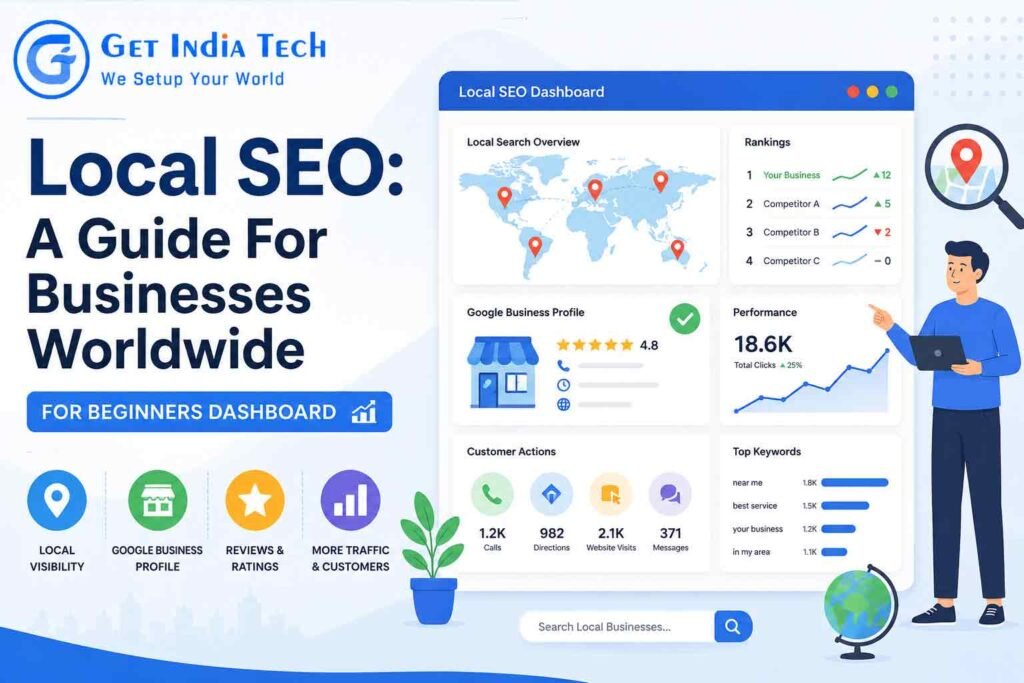
Local SEO helps businesses improve local search rankings, attract nearby customers, and increase organic traffic. This guide covers proven strategies to grow your business in 2026.
Finding customers today isn’t only about having a great product or offering excellent service. People search online before making almost every purchasing decision. Whether they are looking for a nearby restaurant, a plumber, a dentist, a clothing store, or even a software company, they usually begin with Google.
That’s where Local SEO becomes one of the most valuable digital marketing strategies for businesses of every size.
Many business owners believe Local SEO only matters if they operate a physical shop. In reality, that’s only part of the story. Service-area businesses, freelancers, agencies, consultants, online brands with local offices, and even international companies can benefit from a strong local search presence.
This guide explains everything you need to know about Local SEO in simple language. You’ll learn how Google ranks local businesses, what optimization techniques actually work, common mistakes to avoid, and how to build a long-term strategy that attracts qualified customers.
Whether you’re a beginner trying to learn Local SEO, a business owner planning Local SEO website development, or a Local SEO developer building websites for clients, this guide will help you understand the complete picture.
What is Local SEO?
Local SEO (Local Search Engine Optimization) is the process of improving your business’s online presence so that it appears in local search results when people search for products or services nearby.
For example, someone might search for:
- Best dentist near me
- Pizza delivery in New York
- Local web development company
- SEO agency in London
- Car repair shop nearby
Google evaluates hundreds of ranking signals before deciding which businesses should appear in these searches.
Local SEO helps improve your visibility in:
Unlike traditional SEO, which often targets national or global audiences, Local SEO focuses on attracting customers from specific geographic areas.
Why Local SEO Matters More Than Ever
Consumer behavior has changed dramatically over the past decade.
Instead of asking friends for recommendations, people now trust search engines to help them make decisions.
According to Google’s own guidance, local searches often indicate strong purchase intent. Someone searching for “electrician near me” is usually looking to hire one soon—not just browsing.
That makes Local SEO one of the highest-return marketing investments for many businesses.
Benefits include:
- Increased website traffic
- Higher-quality leads
- More phone calls
- More direction requests
- Better brand trust
- Increased store visits
- Higher conversion rates
- Long-term organic growth
Who Needs Local SEO?
One of the biggest misconceptions is that Local SEO only benefits small local shops.
In reality, businesses across industries can benefit.
Examples include:
Retail Stores
- Clothing stores
- Grocery stores
- Electronics shops
- Furniture stores
Healthcare Providers
- Dentists
- Doctors
- Clinics
- Physiotherapists
- Chiropractors
Home Services
- Electricians
- Plumbers
- Roofers
- Painters
- HVAC companies
Professional Services
- Lawyers
- Accountants
- Financial advisors
- Insurance agencies
Hospitality
- Hotels
- Restaurants
- Cafés
- Bakeries
Educational Services
- Coaching institutes
- Training centers
- Schools
- Tutors
Digital Businesses
Even companies that provide Local SEO online services, web design, or digital consulting can improve visibility by optimizing for cities, regions, or service areas.
Many agencies specializing in Local SEO web development create location-focused pages that help attract businesses from multiple geographic markets.
How Does Google Rank Local Businesses?
Google uses several ranking signals to determine which businesses appear in local search results.
The three primary factors are:
Relevance
Google wants to match the user’s search with the most relevant business.
A complete Google Business Profile, accurate business categories, relevant services, and detailed website content help improve relevance.
Distance
Google also considers how close a business is to the searcher’s location.
If someone searches “coffee shop near me,” businesses closer to the user generally have a better chance of appearing.
However, distance alone doesn’t determine rankings.
Prominence
Prominence measures how well-known and trustworthy a business appears online.
Google looks at signals such as:
- Customer reviews
- Website authority
- High-quality backlinks
- Brand mentions
- Business citations
- Content quality
- Overall online reputation
This is why businesses investing in Local SEO development often focus on both website improvements and reputation management.
The Core Elements of Local SEO
Successful Local SEO isn’t built on one tactic. It combines multiple optimization efforts that work together.
The foundation includes:
Google Business Profile
A fully optimized business profile.
Website Optimization
Fast loading pages, mobile-friendly design, and helpful content.
Local Content
Location-specific service pages and blog articles.
Reviews
Positive, authentic customer reviews across trusted platforms.
Local Citations
Consistent business information across directories.
Technical SEO
Clean site architecture, structured data, XML sitemaps, HTTPS, and Core Web Vitals.
Local Link Building
Links from trusted local organizations, news websites, business associations, and community partners.
Businesses investing in Local SEO full optimization often combine all of these elements instead of relying on only one strategy.
Why Your Website Still Matters
Many business owners believe their Google Business Profile is enough.
While it plays a significant role, your website remains the foundation of your digital presence.
A well-optimized website helps Google better understand your business, services, locations, and expertise.
Modern Local SEO website development focuses on creating websites that are:
- Mobile responsive
- Fast loading
- Easy to navigate
- Secure with HTTPS
- Optimized for search intent
- Structured with clear headings
- Built for conversions
A skilled Local SEO developer understands how technical SEO, user experience, and content strategy work together to improve rankings and deliver a better experience for visitors.
Optimize Your Google Business Profile
Your Google Business Profile (GBP) is one of the most influential factors in Local SEO. It serves as your digital storefront and often provides a customer’s first impression before they even visit your website.
A complete and well-maintained profile increases your chances of appearing in Google Search and Google Maps while building trust with potential customers.
Claim and Verify Your Business
The first step is to claim ownership of your Google Business Profile and complete the verification process. Verification confirms that you are the legitimate business owner, giving you full control over your listing.
Tips
- Use your official business name.
- Select the most relevant primary category.
- Add additional categories only when appropriate.
- Verify your location using Google’s recommended method.
Complete Every Section
Many businesses fill in only the basics, leaving valuable information missing. A complete profile helps Google better understand your business and provides customers with the details they need.
Include:
- Business description
- Phone number
- Website URL
- Business hours
- Holiday hours
- Services
- Products
- Attributes
- Service areas
- Appointment links
- FAQs
- Business opening date
Every field you complete gives Google more context, which can strengthen your Local SEO efforts.
Upload High-Quality Photos
People trust businesses that showcase authentic, high-quality images.
Consider adding:
- Office exterior
- Reception area
- Team members
- Products
- Services in action
- Before-and-after project photos
- Company vehicles
- Awards or certifications
Encourage Customer Reviews
Reviews influence both search rankings and customer decisions. Positive, genuine feedback demonstrates trustworthiness and helps potential customers feel more confident choosing your business.
Best Practices
- Ask satisfied customers for reviews shortly after completing a service.
- Share your review link through email or text.
- Respond to every review politely, whether positive or negative.
- Never purchase fake reviews.
Thoughtful responses also show that your business values customer feedback, which supports the trust component of Google’s E-E-A-T principles.
Local Keyword Research
Keyword research is the foundation of every successful Local SEO strategy.
The goal is to understand exactly what your audience searches for when they need your products or services.
Examples
- Roofing company in Chicago
- Family dentist London
- Wedding photographer Toronto
- Digital marketing agency Dubai
- Local SEO consultant
- Local SEO developer
- Local SEO online services
Instead of focusing only on high-volume keywords, prioritize search intent. Someone searching for “emergency plumber near me” is much closer to making a purchase than someone searching for “how plumbing works.”
Types of Local Keywords
Service + City
Example:
- SEO agency in New York
Service + Near Me
Example:
- Dentist near me
City + Service
Example:
- Dallas accounting firm
Neighborhood-Based
Example:
- Coffee shop in Downtown Seattle
Service Area Keywords
Ideal for businesses serving multiple locations without physical offices in each area.
Build Location-Specific Pages
If your business serves multiple cities or regions, create dedicated landing pages for each location.
For example:
- /local-seo-london
- /local-seo-new-york
- /local-seo-sydney
Each page should include:
- Unique content
- Local customer testimonials
- Area-specific services
- Driving directions (if applicable)
- Frequently asked questions
- Local landmarks
- Relevant images
Avoid copying the same content across different location pages. Duplicate content provides little value and can weaken your overall SEO performance.
On-Page Local SEO Optimization
A well-optimized website helps search engines understand your content while improving the visitor experience.
Optimize Page Titles
Include:
- Primary service
- Target location
- Brand name
Example:
Local SEO Services in Toronto | ABC Digital Agency
Write Effective Meta Descriptions
Although meta descriptions don’t directly affect rankings, they influence click-through rates.
A compelling description should:
- Include the target keyword
- Highlight your unique value
- Encourage users to click
Use Proper Heading Structure
Follow a logical hierarchy:
- H1
- H2
- H3
This makes your content easier for both users and search engines to understand.
Optimize Images
Every image should include:
- Descriptive file name
- Relevant alt text
- Compression for faster loading
- Modern formats like WebP
Example:
File Name:
local-seo-web-development.webp
Alt Text:
Local SEO web development strategy for business websites
Create Helpful Content
Google increasingly rewards content that answers real questions and provides practical solutions.
Write articles about:
- Local events
- Industry updates
- Customer success stories
- Community involvement
- Seasonal services
- Common customer questions
If your business specializes in Local SEO website development, create educational content explaining how websites influence local rankings. If you offer Local SEO online consulting, publish step-by-step guides that demonstrate your expertise.
Helpful content builds authority and encourages visitors to return to your website.
Maintain NAP Consistency
NAP stands for:
- Name
- Address
- Phone Number
These details should remain identical across:
- Your website
- Google Business Profile
- Business directories
- Social media profiles
- Industry listings
Even small inconsistencies—such as abbreviating “Street” in one place and spelling it out in another—can create confusion for search engines and customers.
Regularly audit your online listings to ensure your business information is accurate and up to date.
Add Local Business Schema Markup
Schema markup is structured data that helps search engines better understand your website.
For local businesses, adding LocalBusiness schema can enhance your visibility by providing details such as:
- Business name
- Address
- Phone number
- Opening hours
- Reviews
- Geographic coordinates
- Website URL
While schema doesn’t guarantee higher rankings, it improves the way search engines interpret your business information.
Mobile Optimization
Most local searches happen on smartphones. If your website is difficult to use on mobile devices, visitors are likely to leave before taking action.
Ensure your website:
- Loads quickly
- Uses responsive design
- Features readable text
- Includes clickable phone numbers
- Has easy-to-use navigation
- Displays clear calls to action
Mobile usability is a critical part of both user experience and Local SEO development.
Prepare for Voice Search
Voice assistants have changed how people search online. Instead of typing short phrases, users ask complete questions.
Examples:
- “Where is the nearest bakery?”
- “Who offers Local SEO services near me?”
- “Which Local SEO developer has the best reviews?”
To optimize for voice search:
- Write in natural language.
- Include question-and-answer sections.
- Use conversational headings.
- Target long-tail keywords.
- Keep business information accurate.
Build High-Quality Local Backlinks
Backlinks remain one of the strongest signals of authority in Google’s ranking system. When reputable local websites mention or link to your business, search engines gain greater confidence in your credibility.
Rather than chasing a large number of links, focus on earning links from relevant and trustworthy sources.
Where to Get Local Backlinks
Some effective opportunities include:
- Local business associations
- Chambers of commerce
- Community organizations
- Local newspapers
- Industry blogs
- Universities and educational institutions
- Charity sponsorships
- Event partnerships
- Supplier and partner websites
- Local podcasts
For example, if your company provides Local SEO website development, writing an expert article for a regional business association can earn both valuable exposure and a high-quality backlink.
Create Link-Worthy Content
People naturally link to content that provides genuine value.
Ideas include:
- Local market reports
- Industry statistics
- Step-by-step guides
- Original case studies
- Business checklists
- Research articles
- Customer success stories
This type of content demonstrates expertise and encourages other websites to reference your work.
Build Local Citations
A citation is any online mention of your business’s Name, Address, and Phone Number (NAP).
Even when a directory doesn’t link to your website, consistent citations help search engines verify your business information.
Popular Citation Sources
- Google Business Profile
- Bing Places
- Apple Maps
- Yelp
- Better Business Bureau
- Facebook Business
- Yellow Pages
- Industry-specific directories
- Local business directories
Before submitting your information, ensure that every listing matches your official business details exactly.
Improve Website Speed
A fast-loading website benefits both visitors and search engines.
Slow websites often experience higher bounce rates, lower engagement, and fewer conversions.
Speed Optimization Tips
- Compress images
- Use modern image formats such as WebP
- Minify CSS and JavaScript
- Enable browser caching
- Use a reliable hosting provider
- Reduce unnecessary plugins
- Implement lazy loading for images
- Optimize fonts and scripts
Website performance is a core element of Local SEO web development because users expect pages to load quickly on all devices.
Focus on Core Web Vitals
Google uses Core Web Vitals to measure user experience.
The three primary metrics are:
Largest Contentful Paint (LCP)
Measures how quickly the main content loads.
Interaction to Next Paint (INP)
Measures responsiveness after a user interacts with your page.
Cumulative Layout Shift (CLS)
Measures visual stability and prevents unexpected layout movement.
Improving these metrics enhances usability and supports stronger search performance.
Technical SEO for Local Businesses
Technical SEO ensures that search engines can crawl, understand, and index your website efficiently.
Essential Technical Checklist
- HTTPS security
- XML sitemap
- Robots.txt file
- Mobile responsiveness
- Structured data
- Canonical tags
- Clean URL structure
- Broken link monitoring
- 404 page optimization
- Internal linking
- Breadcrumb navigation
A strong technical foundation supports every other aspect of Local SEO development.
Common Local SEO Mistakes to Avoid
Even experienced businesses can overlook basic issues that limit their visibility.
Avoid These Mistakes
- Incomplete Google Business Profile
- Duplicate business listings
- Inconsistent NAP information
- Thin location pages
- Keyword stuffing
- Ignoring customer reviews
- Publishing duplicate content
- Slow website speed
- Poor mobile experience
- Outdated business hours
- Low-quality backlinks
- Missing schema markup
- Broken internal links
Regular audits help identify and resolve these issues before they affect rankings.
Measure Your Local SEO Performance
Local SEO is an ongoing process. Tracking results helps you understand what is working and where improvements are needed.
Key Metrics to Monitor
- Organic traffic
- Local keyword rankings
- Google Maps visibility
- Phone calls
- Website form submissions
- Direction requests
- Click-through rate (CTR)
- Conversion rate
- Customer reviews
- Bounce rate
- Average engagement time
Review these metrics monthly and adjust your strategy based on the data.
Useful SEO Tools
Several trusted tools can simplify your optimization efforts.
Google Search Console
Monitor indexing, search performance, and technical issues.
Google Analytics 4
Track visitor behavior, conversions, and traffic sources.
Google Business Profile Manager
Manage your business information, reviews, and updates.
Google PageSpeed Insights
Analyze website speed and performance.
Google Trends
Discover seasonal and regional search trends.
Ahrefs, Semrush, and Moz
Conduct keyword research, backlink analysis, and competitive research.
These tools can support anyone looking to learn Local SEO or improve their Local SEO learning through practical insights.
The Future of Local SEO
Local search continues to evolve as user behavior and technology change.
Emerging trends include:
- AI-assisted search experiences
- Voice search growth
- Hyper-local content
- Mobile-first experiences
- Visual search
- Zero-click search results
- Personalized search based on user location
- Greater emphasis on trust and authenticity
Businesses that consistently publish helpful content, maintain accurate information, and deliver excellent customer experiences will remain well-positioned for long-term success.
Frequently Asked Questions (FAQs)
1. What is Local SEO?
Local SEO is the process of optimizing a business’s online presence to improve visibility in local search results and Google Maps.
2. Why is Local SEO important?
It helps nearby customers discover your business, increasing website traffic, phone calls, and in-store visits.
3. Who should invest in Local SEO?
Any business serving customers in a specific geographic area, including retailers, restaurants, healthcare providers, and service professionals.
4. Is Local SEO different from traditional SEO?
Yes. Local SEO targets location-based searches, while traditional SEO often focuses on broader national or global audiences.
5. What is Google Business Profile?
A free Google listing that displays your business information in Search and Maps.
6. How long does Local SEO take to show results?
Many businesses notice improvements within three to six months, depending on competition and consistency.
7. Can online businesses benefit from Local SEO?
Yes, especially those targeting specific cities or service areas.
8. What are local citations?
Mentions of your business’s name, address, and phone number across online directories and websites.
9. Why are customer reviews important?
They build trust, influence purchasing decisions, and can improve local search visibility.
10. What is NAP consistency?
Keeping your business name, address, and phone number identical across all online platforms.
11. Does website speed affect Local SEO?
Yes. Faster websites improve user experience and support stronger search performance.
12. What is schema markup?
Structured data that helps search engines better understand your website and business information.
13. How often should I update my Google Business Profile?
Review it regularly and update business hours, services, photos, and announcements whenever changes occur.
14. What are location pages?
Dedicated website pages targeting individual cities or service areas with unique, locally relevant content.
15. Is mobile optimization necessary?
Absolutely. Most local searches happen on mobile devices.
16. How can I earn local backlinks?
Partner with community organizations, local media, industry associations, and event organizers.
17. Which tools help with Local SEO?
Google Search Console, Google Analytics 4, Google Business Profile Manager, PageSpeed Insights, Ahrefs, Semrush, and Moz.
18. Can I do Local SEO myself?
Yes. Many business owners start independently, while more complex projects may benefit from experienced professionals.
19. What is the role of a Local SEO developer?
A Local SEO developer ensures your website is technically optimized, fast, mobile-friendly, and structured to support better local search visibility.
20. Where can I begin to learn Local SEO?
Start with Google’s official documentation, experiment with your own website, and continue your Local SEO learning through trusted educational resources and practical experience.
Conclusion
Grow your business with Local SEO by improving visibility, earning customer trust, attracting qualified local traffic, and achieving long-term success.
Need expert help? Check out our SEO Services to improve your Google rankings, attract more local customers, and grow your business. SEO Services